How Virtual Reality Is Being Used in Medical Training and Treatment
Virtual reality, or VR, has gone beyond just being a form of entertainment and is now becoming a helpful tool in healthcare.
It creates computer-generated environments that users can explore using a headset.These experiences can be more realistic than what is possible in a traditional classroom or a regular hospital setting.Medical schools, hospitals, researchers, and healthcare professionals are all looking into how VR can be used for teaching and treating patients.One of the main uses of VR in medicine is for training.Students and healthcare workers can practice medical procedures in simulated environments without directly working on real patients.This allows learners to repeat tasks, learn from mistakes, and become more comfortable with complex situations.VR is also being used in some areas of treatment and rehabilitation.Depending on the application, these immersive experiences can help patients with pain management, physical rehabilitation, practice certain movements, or deal with psychological issues under professional guidance.However, VR is not a substitute for doctors, nurses, therapists, or standard medical care.Its effectiveness depends on good design, clinical proof, trained professionals, and proper use.
Virtual Reality Is Changing How Medical Students Practice
Traditional medical education includes lectures, textbooks, demonstrations, lab work, and supervised clinical experiences.
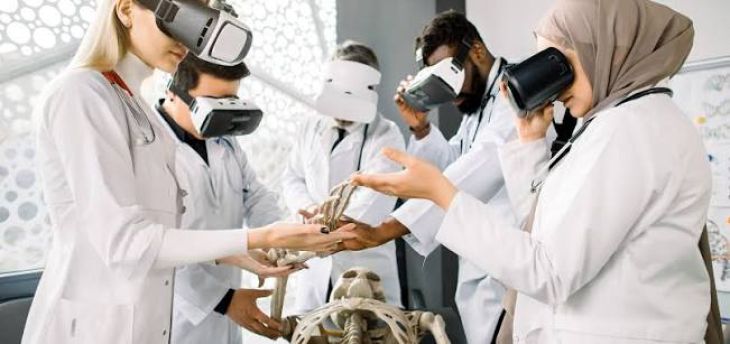
Virtual reality adds another dimension by allowing learners to enter interactive three-dimensional simulations.Instead of just reading about anatomy or watching a demonstration, students can explore virtual structures and practice procedures in a controlled setup.For instance, a VR simulation may let a learner examine the human body layer by layer or practice the steps of a medical procedure.Some systems offer instant feedback, helping students spot incorrect movements or decisions.This makes practice more interactive and helps build confidence before working with real patients.Another benefit is that VR scenarios can be repeated many times, allowing learners to keep improving through practice.Training programs can also expose students to rare or high-risk situations that might not come up often in regular classes.VR can also support team-based training.Doctors, nurses, paramedics, and other professionals can take part in simulated emergencies and practice communication, coordination, and decision-making.However, virtual simulations should not replace supervised clinical experience.Real patients have unique needs and unexpected situations that simulations can't fully capture.VR works best as part of a broader medical education program.
Using VR for Rehabilitation and Physical Therapy
Virtual reality is also being tested as a tool for rehabilitation.
Physical therapy often involves repetitive exercises that some patients may find boring or hard to keep up with over time.VR can make these exercises more engaging by placing patients in virtual environments where movement becomes part of a task or game.For example, a rehabilitation program might ask a patient to reach for virtual objects, maintain balance, or do controlled movements.Sensors can sometimes track body movement, allowing software to give feedback.Therapists can use this information to tailor activities based on the patient's abilities and treatment goals.VR-based rehabilitation has been studied in areas like stroke recovery and other conditions that affect movement and coordination.It may help patients stay more active in their therapy and give therapists another way to monitor progress.The technology can also make therapy sessions more enjoyable.
Exploring VR for Pain Management and Psychological Care
Another area of medical research involves using virtual reality to help patients deal with certain types of pain or distress.
During immersive VR experiences, attention can be directed toward a virtual environment, which may help reduce how much someone focuses on an uncomfortable medical experience.Researchers have looked into the use of VR in situations like specific medical procedures, rehabilitation sessions, and emergency care.Unlike traditional pain medications, VR may work by changing how attention and engagement are directed.
The effectiveness of virtual reality can change based on the patient, the kind of pain they're dealing with, and how the virtual experience is designed.
VR is also being looked at for use in mental health treatments.Doctors can use specially made virtual environments to set up safe situations for therapy exercises.In some cases, these virtual scenes might help patients slowly face their fears or try out ways to deal with stress.
Despite its promise, VR has some challenges that healthcare providers need to think about.
One big issue is cost.To use VR, you need good quality headsets, special software, tracking tools, maintenance, and training for staff — all of which can be expensive.Smaller clinics or schools may not have the money to get these advanced systems.Another problem is proof.Some VR uses have good research behind them, but others are still being tested.Doctors should have solid medical evidence before using VR in regular treatment.A technology might look great, but it doesn’t always mean it helps in a real medical way.Also, comfort is important.Some people feel sick, dizzy, have eye strain, or headaches when using VR gear.Keeping the headsets clean and managing germs is especially important when multiple people use the same equipment.
Virtual reality is becoming a useful tool in healthcare for teaching medical students, helping patients recover, managing pain, and in some therapy areas.
Its main advantage is creating controlled, interactive experiences that can be repeated and tailored to each person's needs.For students, VR gives extra chances to study body structures and practice procedures.For patients, it can make rehab more interesting and offer another way to deal with certain types of pain or take part in therapy.However, VR has important limits.It can't copy everything about real medical care, and not everyone will find it helpful.